As a heavy vibe coding enthusiast, I find myself increasingly drawn to pure "automation" — ideally, the AI shouldn't need to ask me a single question, not a single manual action should occur. I've even started using the --dangerously-skip-permissions flag in Claude Code, something I initially resisted.
But the moment I want to spin up a quick webpage and actually take it live — not just run it locally — the "manual transmission" drudgery kicks in: you need to create a GitHub repo, buy a domain, link your repo to Vercel, and on and on. It's maddening. Just as I was wrestling with this friction, Cloudflare stepped up — introducing "Temporary Cloudflare Accounts for AI agents." They kicked down this wall with a solution that is both brutally crude and profoundly elegant.
Think of it as Claude Artifacts deployed on the real public cloud, with a built-in self-destruct timer. With a single command, any temporary deployment stays live in the cloud for 60 minutes. You get a test URL and a claim link for the temporary account. During that window, you can claim the account to make it permanently yours. If you don't, it expires automatically after 60 minutes. Your code no longer needs to sit on a fixed, heavy server — instead, it floats like a ghost across global network nodes, waking up and executing the moment a request arrives. In the old world, opening a store meant renting a fixed physical shop. Now Cloudflare gives you a "holographic projection system" — your store can materialize instantly at any street corner on the planet, serve its purpose, and vanish. Near-zero cost.
This was genuinely exciting news, so the moment I saw it, I stayed up late to test it.
To use this feature, you only need two things:
- A terminal with Node.js (v22 or latest).
- Install or update Wrangler CLI to version 4.102.0 or higher.
If you've never touched Wrangler CLI before, don't worry — just run:
npm i -D wrangler@latest
Once installed, verify with npx wrangler -v. If everything worked, you should see something like:

With the foundational environment cleaned up, it was time to fully hand over the reins. I couldn't even be bothered to read the lengthy official API docs. I just needed to know the core command — npx wrangler deploy --temporary — and I threw the rest of the grunt work at Claude Code in plain language:
"Write a minimal TypeScript Cloudflare Worker for me. Requirements: when accessed, return JSON containing the current system time and a geeky joke about 'AI replacing human coding.' Deployment: after writing the code, run npx wrangler deploy --temporary directly in the current directory to deploy it to the cloud. Note: do not ask me any confirmation questions — just execute and give me the temporary test URL at the end. Also generate a README."
Claude Code got to work immediately:

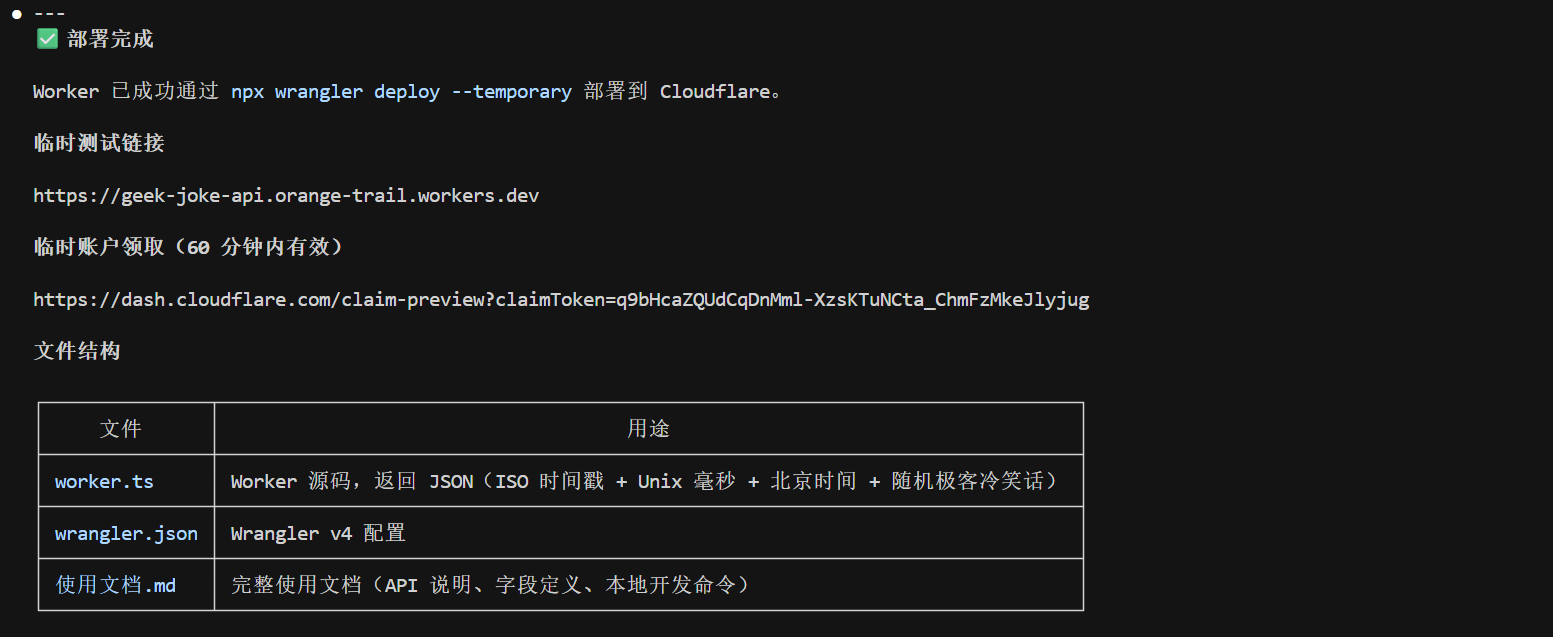
Done in under two minutes:
Opening the test URL in a browser, the page was already live:
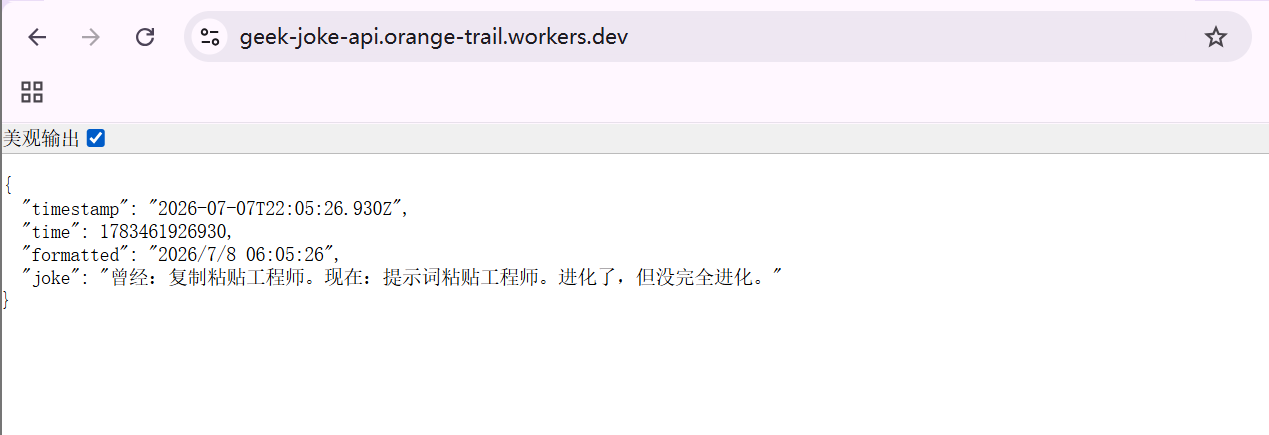
The entire process required zero clicks or keystrokes from me. From the moment I pressed Enter to a globally-accessible, real-deployment API going live: under 2 minutes. I never even opened a browser.
To verify this fully autonomous, human-free loop, I didn't even bother switching to a browser. I issued a second command to Claude Code directly in the terminal: "Use curl to hit the URL you just deployed, read the returned JSON, and verify the timestamp is current." Seconds later, the terminal displayed logs of Claude Code requesting and confirming its own output. That moment felt profoundly futuristic — it wrote the code, it deployed the environment, and now it was even doing QA on itself.
But since it was a simple test with a barebones prompt, the output was a bit dull. With no manual re-deployment overhead, I decided to push further — iterative refinement directly on the temporary deployment. I told Claude Code: "The current response format is too plain. Add a simple HTML frontend to this API with a Matrix-style green terminal theme to render the joke, then overwrite the current temporary deployment."
Even faster this time — under 30 seconds. When I opened the link again, the page had already transformed:
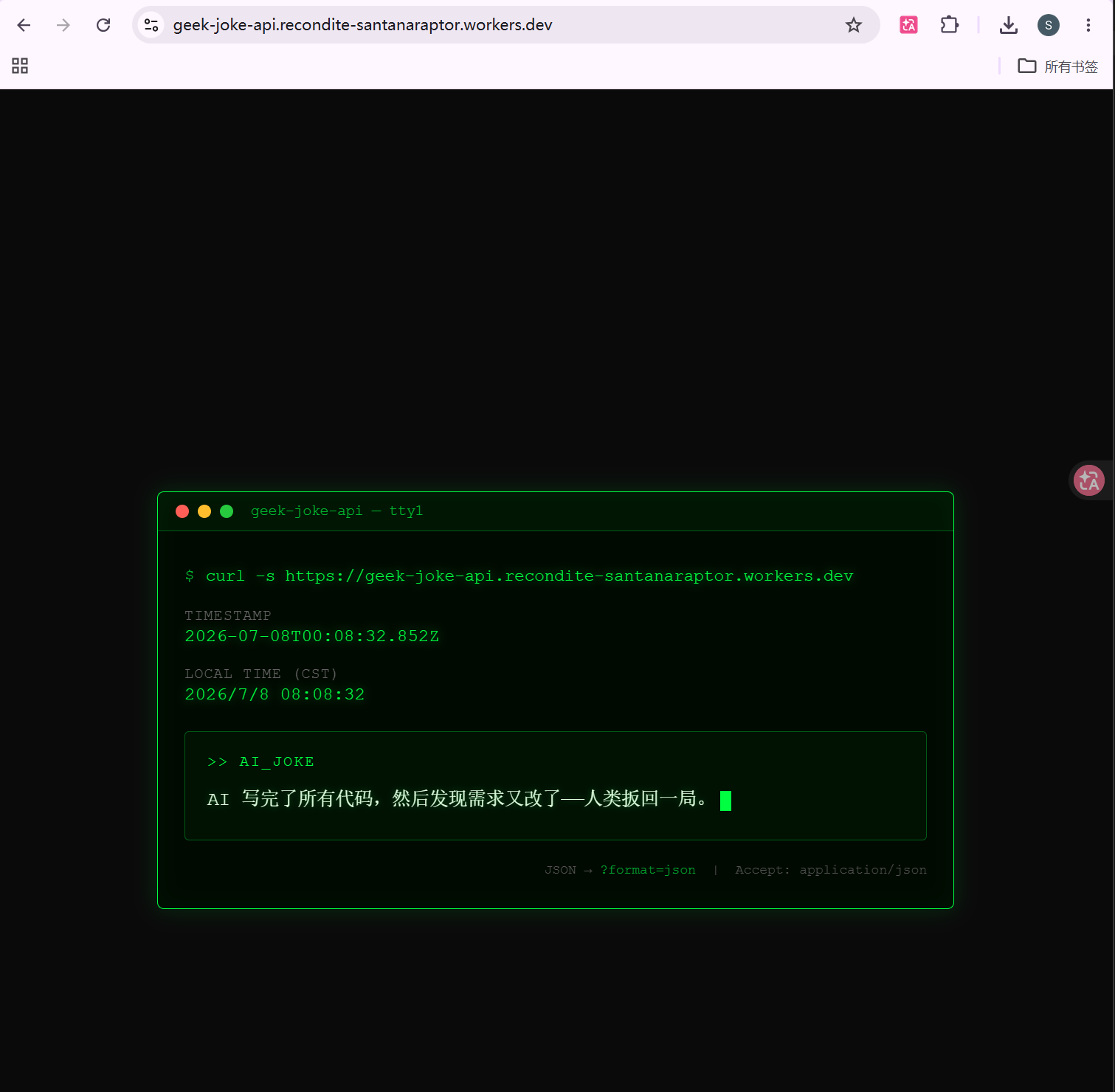
No authorization, no manual deployment — changes visible on the public internet immediately. Isn't this exactly the rapid iteration loop I've been dreaming of? A typical update used to take at least 2 minutes to go live. Now that gap has shrunk to near-zero, and I still haven't opened a browser.
Next, I tried claiming the account. The process was seamless — just one button:
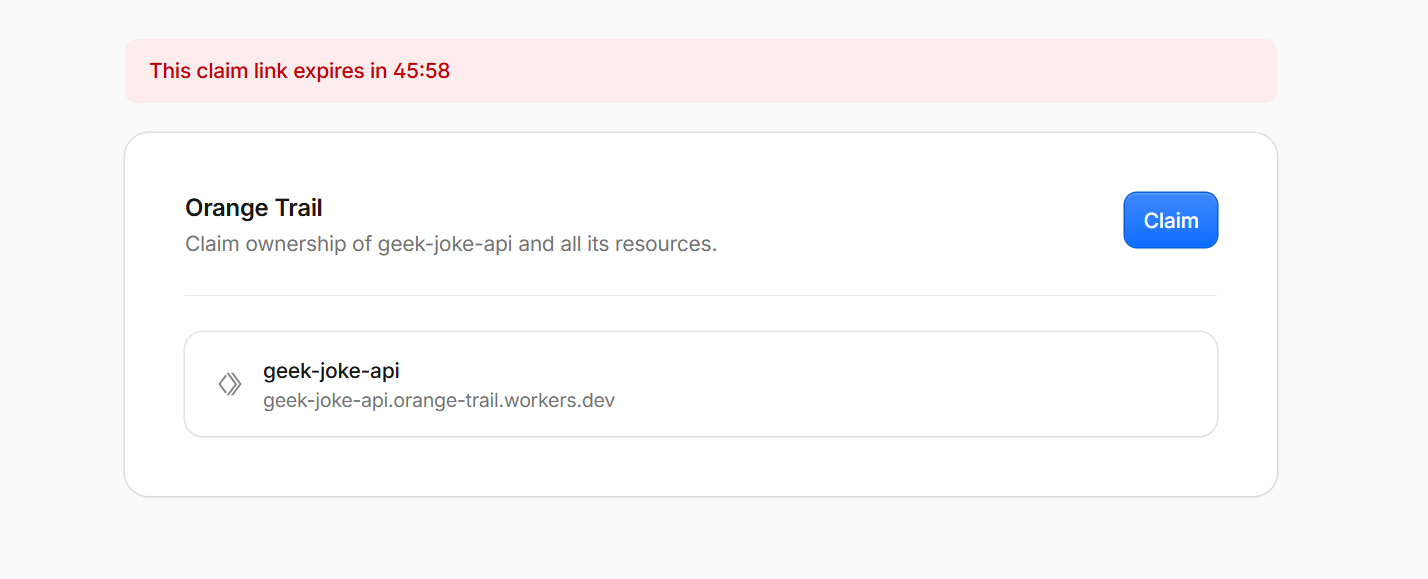
Click "Claim," and the page was permanently mine. The entire flow was so fluid I barely registered any friction. Since I claimed the temporary account, you should be able to visit the URL in your browser right now and see the result.
The core appeal of this feature is the sensation of "real-time public deployment" — no more localhost self-indulgence. True "think it, ship it."
Deeper Reflection: This Is More Than a CLI Feature
The testing phase is over, but I want to dig deeper into what this means. As exhilarating as the feature is, it's not without significant issues at this stage. Because deployments happen under an AI-native identity, the entire process is free of charge (even after claiming, you get 100,000 free requests per day). This "frictionless" and zero-cost trust model also means malicious AI could exploit those 60 minutes with high-frequency concurrent requests to generate phishing pages or siphon compute. But this same "frictionless" and zero-cost trust is precisely what makes Cloudflare's move revolutionary.
In the traditional internet rulebook, all infrastructure — servers, databases, domains — is designed around human physical identity. One person, one ID card, one credit card, one phone number, one 2FA code.
When AI attempts to deploy code, the "friction" it encounters is, on the surface, technical tedium. At its core, it's the rejection and distrust of "machine identity" by traditional infrastructure. The old guard treats every visitor without a human certificate as, by default, a "thief" or a "malicious crawler."
Cloudflare's --temporary accounts, on the surface, eliminate the signup flow. But philosophically, this is the first time a public cloud platform has issued a legitimate, temporary digital ID to a machine. This marks a major step in the internet's transition from human-centric to machine-native architecture.
The past year of AI evolution has been a painful chronicle of "forcing AI to cosplay as a human" — teaching AI to use Puppeteer to mimic human button clicks, teaching AI to bypass CAPTCHAs designed for humans, teaching AI to manage complex environment variables. It's profoundly inefficient. Cloudflare's approach represents a fundamental paradigm shift for the next generation of cloud services: infrastructure should not force AI to adapt to human authentication systems — it should provide "machine-native" identity directly. The 60-minute lifecycle is an exquisitely balanced compromise between machine efficiency and human peace of mind.
After clicking "Claim" and watching this fully AI-built application integrate into my account, I instinctively searched for the credit card binding page — and found nothing. No hidden bills. Still 100,000 free requests per day. This is the infrastructure logic of a new era: AI creates the assets, and cloud providers supply an authentication-free, zero-cost digital sandbox. The greatest friction has been removed. Now it's up to the AI agents — armed with "native identity" — to see what kind of storms they can unleash in this playground.
Closing Thoughts
AI stands at a watershed moment. In the past, even Claude Code's power and capability were tightly confined within a "sandbox" or a "chat window." It had no means of production, no access to the open sea — it relied on humans as the physical vessel to transport its output into real-world servers. At that stage, AI was merely a tool. When "AI-native identity" and "frictionless deployment" converge, the DNA of the internet changes. AI gains the ability to instantaneously create assets in the real digital world. It thinks of an idea, and the next second, that idea is already a live, breathing API on the public internet. Even if the application only lives for 60 minutes, it possesses a complete existence within that hour. This means AI is beginning to wean off human nurturing, beginning to self-replicate, self-test, and self-evolve in the cloud. AI has transformed from a "content generator (AIGC)" into an "application and asset generator."
We are still witnessing history.